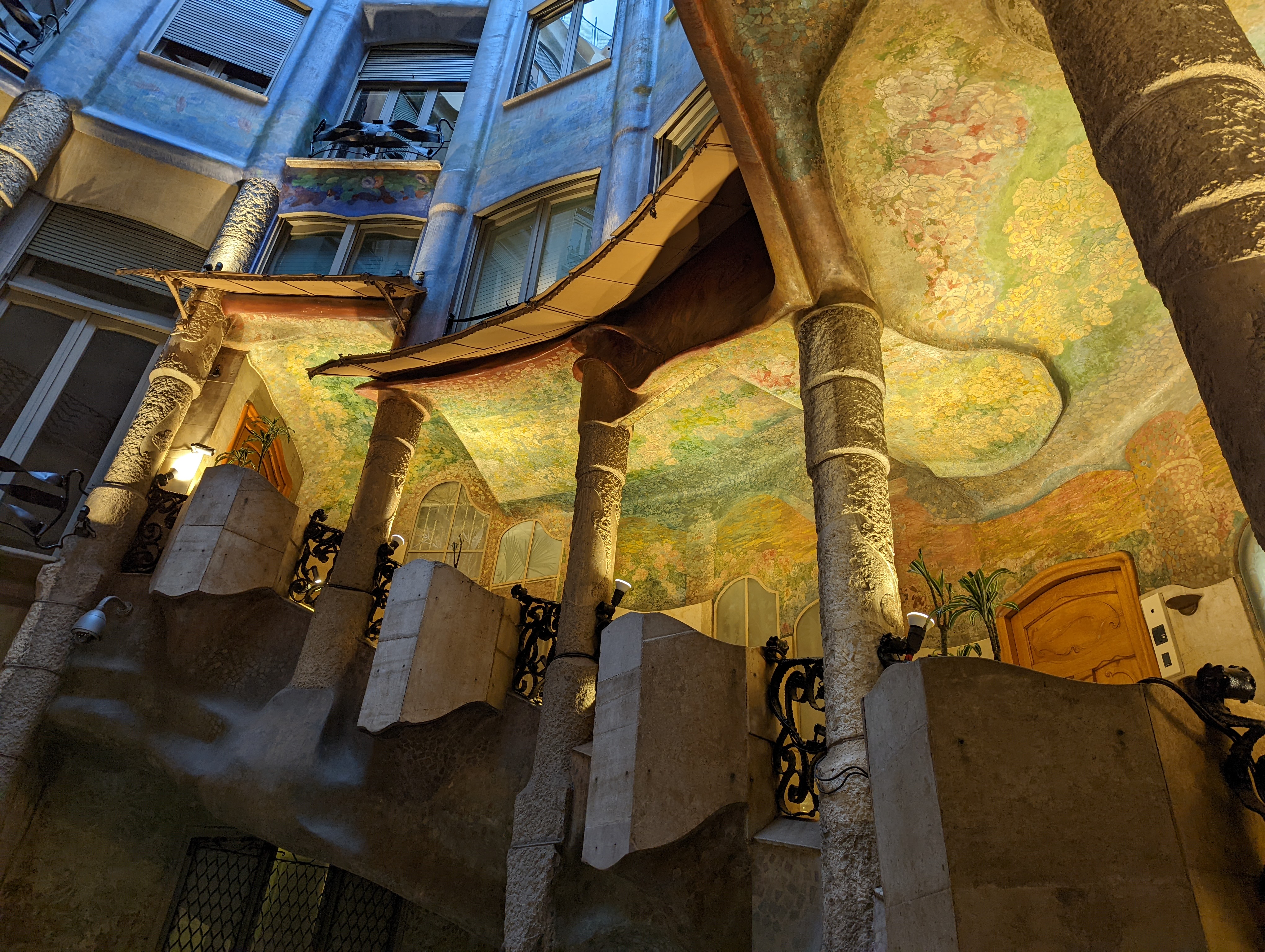
“The architect of the future will be based on the imitation of nature”, Gaudi.
I experienced La Padrera today. Or Casa Mila as it’s sometimes called. (Mila was the patron or customer who hired Gaudi to complete this work.) I have not seen another structure like this.
When I first perused Gaudi’s work online before coming to Barcelona, I thought of Dr. Seuss. Gaudi’s work looked partially deranged to me. Was he a nihilist who wanted the worthlessness of existence to be portrayed in his work? Was he drunk and we’ve decided that the inexplicablness of his work is what makes it great? Was he supremely playful and had perhaps children in mind (and drugs in his body) when he built his structures? This is what I wondered. I am delighted to learn how wrong I was!
Do you remember in high school, or perhaps younger, first looking at drawings of the inner parts of the human body? Did it look ugly to you? It did to me! Organs were squishy and weird. (Note: “weird” usually means “I’m not used to this” or “this is new” thus it carries little meaning.) Nothing was symmetrical (in a way that I could observe) or like what I was used to seeing outside the body (i.e. it was weird). Thus it was not beautiful. It was generally ugly. I think over time a person, who increases in knowledge of the body, would find it beautiful.
Gaudi, in his effort to imitate nature, did something weird. It is much simpler to do straight lines and ignore texture. But nature is filled with curves, layers and layers of texture, and a beauty that may not be immediately recognized as beauty. Of course, some parts of nature we all immediately agree is sublimely beautiful: waterfalls, birds, the sunset. It appears to me that Gaudi has imitated both the obviously beautiful (example his butterfly door) and the less obviously beautiful (the shape of the front of La Padrera).
I only have seven minutes left before the next day arrives and I’m no expert on Gaudi. I was moved. I was inspired. I like this gentlemen. He broke a lot of rules (and followed a lot of rules! i.e. all the math and planning involved in the mechanical part of his structures). He dedicated himself. Part of his story seems very sad (how alone he was at the end of his life) but much of his story seems filled with passion and life, which he shares with us today.
 Musings