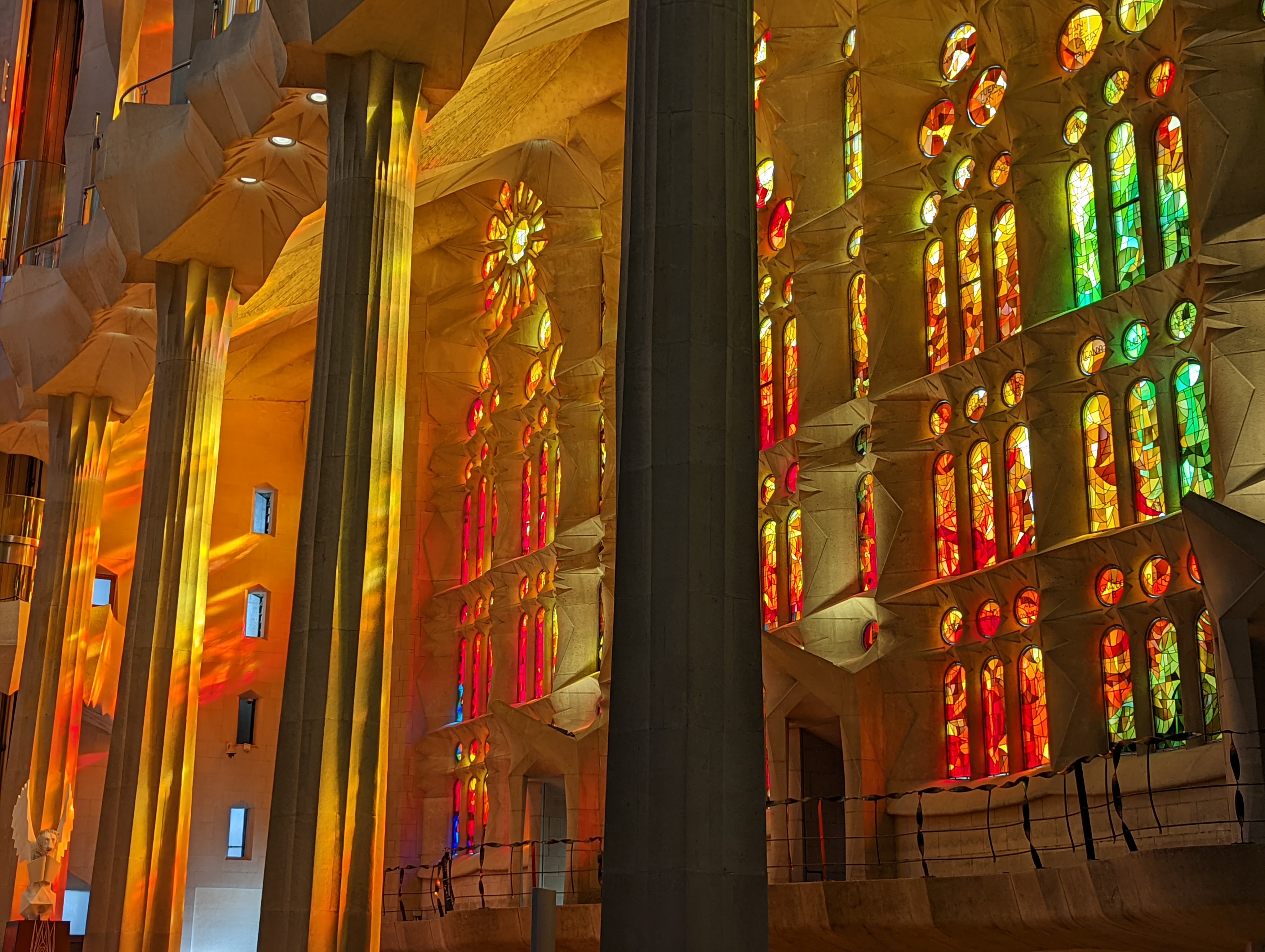
Light and color. These two words best describe experiencing the inside of La Sagrada Familia. It almost feels sacrilegious to put my experience into words. I was in a large tour group. Our delightful and gregarious tour guide let us know that around 10,000 visitors experience the basilica in a day. So, my friends, I am 1 in 10,000. And that is only today! Here is my experience: I was moved to tears. I held them back, but the atmosphere was so intensely joyful and like no other I had experienced. I am struggling to find the words. To enter a cathedral of, what felt like, boundless rays of color filling the vaulted space overhead was like, well, it was like how I colored as a child: I used every crayon in the box. Or it was like the stickers I chose as a child: wild colors! All of them! There is something playful about using all the colors. Something festive. It says we’re throwing all the doors open! No holds barred!
I’ve learned color and light are intertwined: increased light means increased vibrancy of color. Gaudi restructured the main sanctuary twice in order to get more light, which in turn allows more color. I am a grateful recipient of his work.
I was surrounded by hundreds and thousands of people but the moments in the sanctuary still felt special and intimate. I have never experienced a piece of architecture in my life that made me feel so enveloped in color. So, loved! Gaudi attended church twice daily. He was devout. He was Catholic. If I remember correctly, he refused to be paid for his work on the basilica. He worked on it 42 years. He believed he had God-given skills that he was meant to share with the world. It appears he was right!
La Sagrada Familia is a story book. And fascinatingly much of the story is on the outside of the building. Historically, people could not read, so the Catholic church told the events of the faith to its people through sculptures inside the building. Gaudi reversed that: the sculptures are on the outside. And given how mammoth his structure is, he can tell much of the Bible! There’s the passion facade, the nativity facade, the resurrection, and I don’t remember the other.
His work is an inviting retelling of the faith. Who doesn’t want to be enveloped in light and color?! Surrounded in awe. Stunned if but for a while. Feeling small inside what may be the tallest religious building in the world. Gaudi tells the story of Jesus in a way that people want to hear it: the excellence of his piece of work calls us and the story is “told” through light, color, and statue after statue.
I get the idea that coming as sunset is arriving is best. I was there between 3:45 and 6:30. There are hundreds more things to be said on this work of art, the passion of its maker (Gaudi), the philosophy of Gaudi, and the love between man and God. But, my time is up! I will most likely edit this piece over time to make it what it should be.
I will always remember Barcelona for its vibrancy!
 Musings